

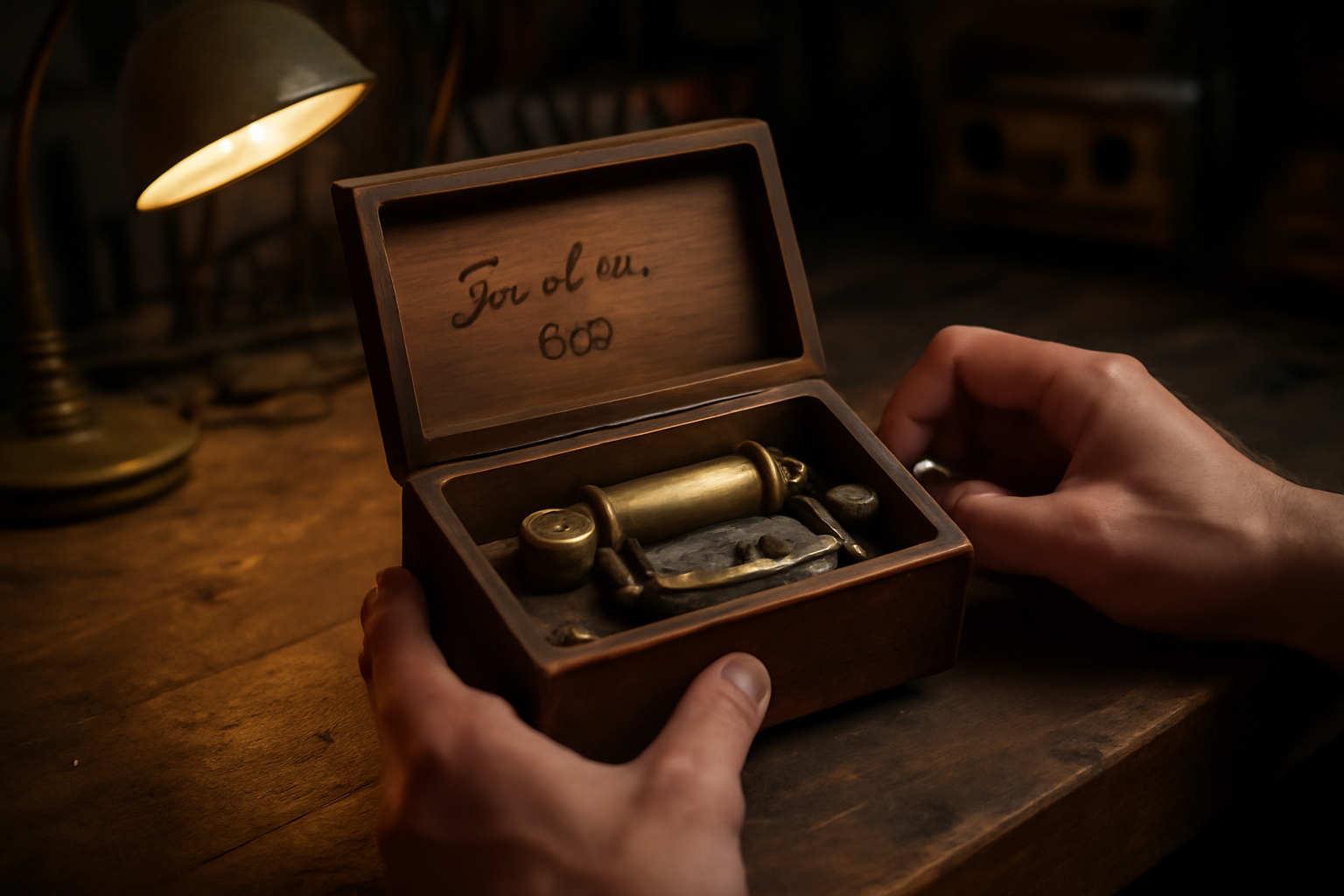
He found the music box in a box of junk that should’ve been thrown out years ago.
It was at the bottom of a cardboard crate in the back of his grandfather’s old shop, buried beneath tangled extension cords, a cracked wall clock, and a ceramic rooster missing half its beak. Dust drifted in the sunlight like lazy snow as Daniel lifted the box, feeling the familiar twinge in his chest that came whenever he stepped into this room.
His grandfather’s place still smelled like metal shavings and coffee. The sign outside still said “Petrov & Son Repairs”, even though the “& Son” had never really worked out and the “Petrov” had died eleven months earlier.
Daniel had come back to clean it out.
Instead, he was sitting on the floor, staring at a music box.
It was the old-fashioned kind: small, rectangular, with a wooden lid and a metal crank on the side. The varnish had worn away in places, revealing pale wood beneath. A thin crack ran along the top, and the hinge creaked when he tested it. A faint pattern was etched around the lid — tiny flowers and stars, the lines almost invisible in the dust.
He brushed it clean with his sleeve.
On the underside, in shaky cursive, someone had written a name:
“For Anna, 1963.”
“Anna,” he murmured. “Who were you?”
He set the box on the workbench out of habit. His fingers moved automatically, the way his grandfather’s had when someone brought in a broken lamp or a stubborn old radio. He tested the crank. It turned, but only for half a rotation before catching.
“Figures,” he said. “You and me both, huh?”
The music box was probably worthless. Some antique dealer might fluff it up with words like “vintage” or “nostalgic charm,” but from a practical standpoint, it was just another thing to toss on the pile.
And yet.
Something about it felt… heavy. Not in his hand — in the room. Like the air around it had thickened.
He sighed. “All right. Let’s see what’s wrong with you.”
The insides were worse than the outside.
He unscrewed the back panel and lifted it away, revealing a nest of rusted gears, a warped comb of metal tines, and a cylinder whose tiny pins were bent at odd angles. A spider had made a home in one corner, and a dried-up husk of something unidentifiable clung to the main spring.
No wonder it jammed.
“Granddad would’ve yelled at whoever let you get this bad,” Daniel muttered. “Probably me.”
He set the parts out carefully on the mat. It felt good, in a way he hadn’t expected, to have a small, solvable problem in front of him. For the last year, everything in his life had been too big — death certificates, estate lawyers, the looming question of what to do with the shop and the life attached to it.
But this? This was manageable. Clean the gears. Straighten the pins. Replace the spring if he had one in the drawers.
He worked in silence, the only sounds the soft tick of his tools and the occasional creak of the floor. Light shifted through the front windows as the afternoon slipped by.
At some point, he realized he was humming.
It wasn’t a song he recognized; just a few notes looping unconsciously, low and comforting. They felt oddly right, like they fit the music box even before it played.
When he finally reassembled everything, his shoulders ached and a fine line of grease traced his cheek. He tightened the last screw and flipped the box upright.
“Moment of truth,” he said.
He turned the crank.
It resisted at first, then loosened, spinning smoothly. The internal mechanisms whirred. The cylinder rotated. The comb tines trembled.
Then the music started.
Simple. Clear. A little wobbly from age, but unmistakably… lovely.
A gentle melody spilled into the dusty workshop. It was sweet and slightly bittersweet, like the kind of song you might dance to in a kitchen when no one was watching. The notes climbed and fell in a pattern that should have been random but somehow felt inevitable.
Daniel froze.
He knew this song.
Not from the radio. Not from a playlist or an album. From somewhere else. Somewhere older.
The memory came in pieces: his grandfather humming in the kitchen, a pot of stew on the stove; a rainy afternoon when Daniel was seven, plastic cars lined up on the floor; an old woman’s laugh — high, bright, warm — though he couldn’t see her face.
The music box played on.
He blinked hard.
“Okay,” he said softly. “That’s… weird.”
He turned the crank again, letting the melody loop. It filled the shop, drifting under the door to the front, into the room where customers used to stand asking if Mr. Petrov could maybe fix this one thing nobody else would touch.
He heard the bell on the front door jingle.
Daniel jumped, nearly dropping the music box.
The sign still said CLOSED; he hadn’t flipped it. The door was locked. At least, he thought it was.
“Hello?” a voice called.
An older woman stood by the counter, gray hair pinned back beneath a knitted hat, coat dusted with the faintest trace of snow — though the street outside was dry. She looked around as if she’d been here before and was checking that everything was still in place.
“I heard you were open again,” she said.
“I’m… not,” Daniel replied, stepping through the doorway into the front room. “We’re closed. I’m just cleaning out.”
Her gaze flicked to the music box in his hands.
“Oh,” she whispered. “Oh, my.”
She moved toward him, each step careful but surprisingly sure. Her eyes shone with something that looked a lot like hope.
“May I?” she asked, gesturing to the box.
He hesitated, then handed it to her.
She cradled it like it was something fragile and precious. Her fingers traced the pattern along the lid.
“You fixed it,” she said. “After all these years.”
“You’ve seen this before?” he asked.
Her smile creased her face in a dozen familiar ways he couldn’t quite place.
“I gave it to him,” she said. “To your grandfather. When he still remembered my name half the time.”
Daniel’s throat tightened. “You knew my granddad?”
She laughed softly. “Everyone here knew your grandfather. But some of us knew him before he opened this shop.”
She wound the crank. The melody started again.
“I sat in that corner,” she said, nodding to the stool by the window, “the day he finished it. He’d built the mechanism from scrap and stubbornness. I told him it would never work.”
“Clearly it did,” Daniel said.
“Oh, we fought about everything,” she said fondly. “Music, food, politics, whether a life can be small and still mean something. He made this for me anyway.”
Her fingers trembled just slightly on the wood.
“I made the mistake,” she added, voice softer, “of leaving before I understood what that meant.”
They stood in silence for a moment, the music filling the spaces between words.
“What’s your name?” Daniel asked.
“Anna,” she said.
He felt a chill run through him.
“The inscription,” he murmured. “On the bottom.”
She turned the box, eyes misting as she read the fading words.
“For Anna, 1963,” she recited. “He used to say time didn’t touch some things. I never believed that either.”
She looked up at Daniel. “You have his eyes, you know.”
He swallowed. “He never mentioned you.”
“He wouldn’t have,” she said. “We had our time. Then life did what it always does. It moved us in different directions.”
“But you came back,” Daniel said.
She closed the lid gently. The music stopped mid-phrase.
“I come into town once a month,” she said. “I walk past this place and tell myself that if the lights are on, I’ll go in. They never were. Until today.”
Something eased in Daniel’s chest.
It had been hard to come back. Harder still to turn on the light in the front window. It had felt presumptuous, like he was pretending to be someone he wasn’t.
“What did the song mean to you?” he asked.
Anna smiled faintly. “To us, it was a promise. We had no money, no plan, no sense. But we had that melody. He told me, ‘When you hear this, no matter where you are, that’s me saying I remember you.’”
She set the box on the counter, resting her hand on it.
“I stopped hearing it when I left,” she said. “Until today.”
The air in the shop seemed to thicken again, but it wasn’t heavy this time. It felt… full.
“Would you like to hear it again?” Daniel asked.
Her eyes shone. “Just once more.”
He turned the crank. The melody spilled out, lilting and warm.
This time, as it played, the bell on the door jingled again.
Three people walked in — a man in his forties with a beard and kind eyes, a woman juggling a toddler on one hip, and an older man Daniel had only ever seen in photographs: his uncle Mark.
“I knew I heard it,” Mark said, breathless. “I was halfway down the street and thought I’d lost my mind. I haven’t heard that song since—”
He stopped when he saw Anna.
She turned slowly.
For a second, the years fell away. In the lines of the older man’s face, Daniel could see the echo of his grandfather. In the way Anna straightened her shoulders, he could see the younger woman in the faded black-and-white photos hidden in the back of drawers.
“Elias?” she asked, voice barely above a whisper.
Mark shook his head, smiling sadly. “No. I’m his brother. But you’re not wrong. He gave me that look the first time he saw you.”
She laughed through a sob. “Stubborn old fool.”
“He would’ve liked to know you came back,” Mark said.
“I didn’t,” she said softly. “Not in time.”
The toddler on the woman’s hip — Daniel’s niece, Emmy — clapped her hands at the sound of the music.
“Pretty,” she declared.
Everyone laughed, because somehow it was the perfect thing to say.
They spent the next hour sharing stories — about the man they’d each known in different ways. Anna talked about the boy who’d stolen cogs from scrap yards to build music boxes. Mark talked about the brother who’d stayed when everyone else left. Daniel talked about the grandfather who’d taught him that fixing things was its own kind of love.
The music box played again and again, the melody never quite the same but always familiar, like a voice humming in the next room.
At one point, Anna rested her hand over Daniel’s.
“Thank you,” she said.
“For what?” he asked.
“For finishing something he started,” she said. “For letting the song out so we could find our way back.”
He didn’t know what to say to that, so he just nodded.
As the afternoon light faded, the small group drifted out of the shop one by one — promises to come back, to bring more stories, to not let another year pass in silence.
Anna was the last to leave.
She paused at the door.
“Your grandfather always worried he’d be forgotten,” she said. “He wasn’t afraid of dying. Only of disappearing.”
She nodded toward the music box on the counter.
“You’ve made sure he didn’t.”
When she stepped outside, the bell chimed softly.
The shop felt different now.
Less like a tomb. More like a place where things started again.
Daniel picked up the music box and turned the crank one more time. The melody filled the empty room, mellow and sure.
He spoke softly, not caring how ridiculous it might sound.
“I remember you,” he said.
The song went on, filling the little repair shop and the street beyond with the kind of warmth that lingers long after the last note fades.